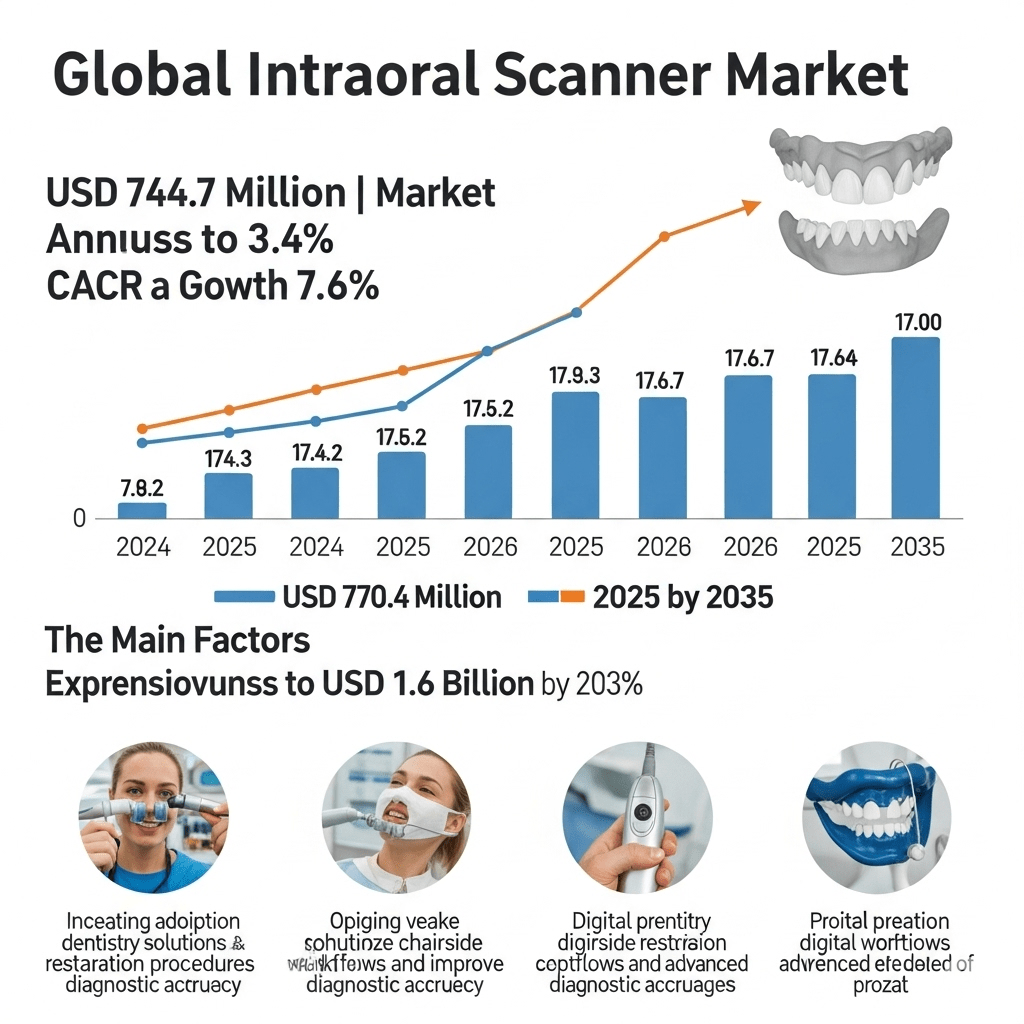
The global intraoral scanner market is expected to witness consistent expansion, with a valuation of USD 770.4 million in 2025, increasing from USD 744.7 million in 2024, reflecting an annual growth rate of 3.4%. By 2035, the market size is projected to reach USD 1.6 billion, driven by a robust CAGR of 7.6% during 2025 to 2035. This upward trajectory is primarily attributed to the adoption of digital dentistry solutions that streamline chairside restoration procedures and improve diagnostic accuracy.
The intraoral scanner market is evolving rapidly due to the growing demand for digital dental solutions. Intraoral scanners are devices used by dental professionals to capture detailed 3D images of a patient’s oral cavity. These scanners replace traditional impression methods, offering enhanced accuracy, patient comfort, and efficiency in dental procedures. The market growth is driven by advancements in scanning technology, increasing awareness of digital dentistry, and rising adoption of CAD/CAM systems in dental clinics.
Key factors fueling the intraoral scanner market include the need for precise digital impressions, reduced treatment times, and improved workflow integration in dental practices. With the increasing prevalence of dental disorders and cosmetic dentistry, the demand for advanced scanning solutions continues to expand globally. Additionally, the shift towards minimally invasive procedures and patient-centric care supports the widespread use of intraoral scanners.
Get Sample Report: – https://www.futuremarketinsights.com/reports/sample/rep-gb-15768
Market Trends
The intraoral scanner market is shaped by several prominent trends that influence its development and adoption:
- Technological Advancements: Innovations such as enhanced imaging resolution, faster scanning speeds, and wireless connectivity are making intraoral scanners more efficient and user-friendly.
- Integration with CAD/CAM Systems: Seamless integration with computer-aided design and manufacturing software is improving the workflow in dental practices and laboratories.
- Increased Use in Orthodontics and Prosthodontics: The demand for precise digital impressions in these specialties is rising, fueling intraoral scanner sales.
- Cloud-Based Data Management: Cloud platforms enable secure storage and easy sharing of digital impressions, enhancing collaboration between dentists and labs.
- Portable and Compact Devices: Miniaturization of scanner hardware is making devices more convenient and accessible for a broader range of dental professionals.
- Growing Demand for Cosmetic Dentistry: As patients seek aesthetic dental treatments, the intraoral scanner market benefits from the need for precise and customized restorations.

Challenges and Opportunities
Despite the promising growth, the intraoral scanner market faces some challenges and offers numerous opportunities for stakeholders:
Challenges:
- High Initial Cost: The upfront investment for intraoral scanner devices can be a barrier for smaller clinics and dental practices.
- Training and Adoption: Dental professionals may require extensive training to effectively use advanced scanning technologies.
- Compatibility Issues: Lack of standardization in software and hardware may lead to integration problems with existing dental systems.
- Data Security Concerns: With increasing use of digital data, ensuring the privacy and security of patient information is critical.
- Competition from Traditional Methods: Some practitioners still prefer conventional impression techniques due to familiarity and cost considerations.
Opportunities:
- Emerging Markets: Growing dental awareness and healthcare infrastructure in developing regions offer vast growth potential.
- Technological Collaborations: Partnerships between scanner manufacturers and software providers can lead to improved products and user experience.
- Expanding Applications: Intraoral scanners can be used beyond dentistry, including in forensic analysis and maxillofacial surgery.
- Personalized Dentistry: Increasing demand for customized dental solutions aligns well with the capabilities of digital scanning technology.
- Rental and Subscription Models: Offering flexible ownership options can lower entry barriers for dental clinics.
Key Regional Insights
The intraoral scanner market varies significantly across different geographic regions, influenced by factors such as healthcare infrastructure, technological adoption, and economic development.
- North America: This region holds a significant share due to advanced healthcare infrastructure, high adoption of digital dental technologies, and presence of leading scanner manufacturers.
- Europe: European countries show steady growth supported by government initiatives promoting digital dentistry and increasing awareness among dental professionals.
- Asia-Pacific: The fastest-growing market driven by rising dental tourism, expanding healthcare facilities, and increasing investments in dental technology.
- Latin America: Emerging market with growing dental care demand but slower adoption due to cost sensitivity.
- Middle East and Africa: Growth fueled by improving healthcare access and increasing awareness, though still in early stages compared to other regions.
Top Companies
Several key players dominate the intraoral scanner market, contributing to technological innovation and market expansion:
- Companies focusing on advanced imaging technology and ease of use are leading the competitive landscape.
- Established dental equipment manufacturers invest heavily in R&D to improve scanner accuracy and integration.
- Some companies offer comprehensive digital dentistry solutions that include intraoral scanners, CAD/CAM systems, and software platforms.
- Strategic partnerships and acquisitions are common to expand product portfolios and enter new markets.
- These top companies emphasize customer support, training, and after-sales service to enhance user experience and loyalty.
Explore In-Depth Analysis-Click Here to Access the Report:- https://www.futuremarketinsights.com/reports/intraoral-scanners-market
Segmentation Outlook
The intraoral scanner market can be segmented based on various factors, providing insights into specific areas of growth:
- By Type: Handheld scanners and tabletop scanners cater to different clinical needs and practice sizes.
- By Application: Orthodontics, prosthodontics, restorative dentistry, implantology, and others reflect diverse uses of intraoral scanners.
- By End-User: Dental hospitals, clinics, and academic institutions use intraoral scanners for different purposes, influencing demand patterns.
- By Technology: Optical imaging, laser scanning, and structured light scanning represent different scanning methods with unique advantages.
- By Price Range: Entry-level, mid-range, and high-end scanners appeal to different segments of the dental market.