Global Oil and Gas Terminal Automation Market to Be Valued at US$ 850 Mn by 2016 End

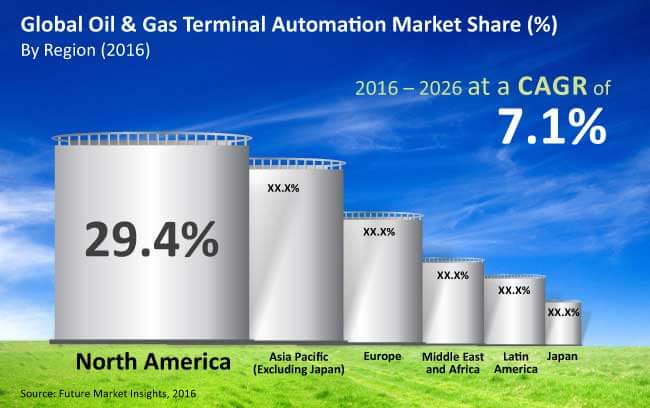
According to a recent market report titled “Oil and Gas Terminal Automation Market: Global Industry Analysis and Opportunity Assessment, 2016-2026” published by Future Market Insights, revenue from the global oil and gas terminal automation market is estimated to be valued at US$ 850 Mn in 2016. It is projected to exhibit 7.1% value CAGR during 2016-2026, and is forecast to be valued at US$ 1,693 Mn by 2026 end. The market is expected to witness nearly 2X growth between 2016 and 2026.

Growing need for liquefied natural gas, coupled with surplus oil and gas production in certain regions of the globe including North America has resulted in increasing focus on development of storage terminals across the globe. Accordingly, increase in investment towards development of oil and gas terminals is likely to be witnessed during forecast period. This, along with the existing demand-supply scenario is expected to boost revenue growth of the global oil and gas terminal automation market in the next 10 years. Growing emphasis on adoption of Wireless technology and Internet of Things (IoT) based terminal automation systems is anticipated to be witnessed during forecast period.

Get | Download Sample Copy with TOC, Graphs & List of Figures: https://www.futuremarketinsights.com/reports/sample/rep-gb-197 

Growing concerns pertaining to cyber security and safety coupled with relatively higher initial capital investment associated with building a completely automated oil and gas terminal are likely to serve as impediments to growth of the global oil and gas terminal automation market between 2016 and 2026.
oil and gas terminal automation market_Image for preview analysis

Segmentation highlights

Global oil and gas terminal automation market has been categorically divided into key market segments based on category and regions. On the basis of category, the market has been segmented into software, hardware, and services segments. These in turn are divided into key sub-segments.

  • The Software category segment is projected to dominate the global oil and gas terminal automation market during the forecast period, accounting for a market share of nearly 38% in terms of value by the end of 2026. On the other hand, the hardware segment is estimated to witness 7.0% CAGR during forecast period to account for a market share of 33.7% in the overall oil and gas terminal automation market by 2026 end. Within the hardware segment, the HMI segment is likely to witness fast growth during 2016 –-2026.

Key Segments

On the basis of categories, the global oil and gas terminal automation market is segmented into:

Hardware

  • ATG
  • Blending Controllers
  • SCADA
  • PLC
  • DCS
  • HMI
  • Safety; Security & Others

Software

  • Terminal & Inventory Management
  • Business System Integration
  • Transaction Management
  • Reporting
  • Others

Services

  • Commissioning
  • Consulting Services
  • Project Management
  • Operations Services
  • Training Services

Regional projections

The North America and Asia Pacific excluding Japan (APEJ) markets are anticipated to emerge the dominant regional markets in the global oil and gas terminal automation market throughout the assessed period. Asia Pacific is estimated to project 8.8% CAGR in the forecast period, 2016–2026. The oil and gas terminal automation market in countries in Eastern Europe is also likely to witness steady growth in the next 10 years.

Vendor insights

The global oil and gas terminal automation market is dominated by a few top market companies such as Honeywell International Inc., Emerson Electric Co., ABB Group, Rockwell Automation, Inc., Yokogawa Electric Corporation, Siemens AG, FMC Technologies, Inc., and Schneider Electric SE. Certain key market companies are increasingly focussing on acquiring smaller players with specialised offerings – for instance, wireless technology based advanced systems – to better cater to the steadily growing global market demands so as to gain an edge over competition.

For More Information or Query or Customization Before Buying, Visit: https://www.futuremarketinsights.com/customization-available/rep-gb-197

About Industrial Automation Division at Future Market Insights

The Industrial Automation & Equipment division at FMI adopts a novel approach and innovative perspective in analyzing the global machinery and industrial automation market. A range of FMI’s market research reports offer comprehensive coverage of capital, portable, process, construction, industrial, and special purpose machinery used across manufacturing sector. The team also conducts distinctive analysis about installed base, consumables, replacement, and USP-feature application matrix, making us a prominent voice of authority in the industry. We are associates of choice for established as well as budding industry
Global Barcode Printers Market Projected to Register a CAGR of 7.4% Between 2016 and 2026 Primarily Driven by Factors Affecting End Use

According to a recent market report published by Future Market Insights titled, “Barcode Printers Market – Global Industry Analysis & Opportunity Assessment, 2016-2026,” revenue generated from sales of barcode printers globally is estimated to be valued at US$ 2,758.0 Mn and pegged at 3,086.8 ‘000 units by 2016 end. It is expected to increase at a CAGR of 7.4% over the forecast period (2016–2026), to be valued at US$ 5,656.1 Mn by 2026 end. In terms of volume, the global barcode printers market is projected to be pegged at 5,384.3 ‘000 units by 2026 end, expanding at a CAGR of 5.7% over the forecast period.

To remain ‘ahead’ of your competitors, request for a sample @ https://www.futuremarketinsights.com/reports/sample/rep-gb-1625 

Barcode printer is defined as an electronic device designed specifically for printing of barcodes. The working principle and built of a barcode printer is slightly different from computer printers as it uses ribbons and labels working in tandem to get a barcode printed. Barcode printers usually don’t have programmable logic controllers on their own, but rely on an external computer system.

Growth in the manufacturing sector is reviving after the 2008 economic crisis. Automation and streamlining of manufacturing processes are being adopted by a large number of manufacturing companies worldwide to reduce time and material wastage, thereby improving efficiency and output. Barcoding is one such technique that is increasingly being adopted. This process has reduced production time considerably in the manufacturing process, thereby driving demand for barcode printers.

Barcodes have become the de facto standard for product information storing and labelling. Retailers worldwide use barcodes for hassle-free recording of supplies and commodities and their sale to customers. Barcodes imprinted on labels are stuck to the products and they record information about the product count, date of manufacture, date supplied to the retailer, selling price, etc.

When these products are scanned, the information is retrieved and monitored. This entire process, which is achieved within a matter of seconds, not only increases efficiency but also minimizes errors. This has helped retailers record their products and inventory on shop floors and warehouses.

However, threat of RFID tags as substitutes to barcode labels and low compatibility of barcode printers with different operating systems act as restraints in the global barcode printers market.

For critical insights on this market, request to ask an expert here @ https://www.futuremarketinsights.com/ask-question/rep-gb-1625 

Segmentation highlights

The market is categorically divided into six segments based on printer type, printing technology, consumables, application, distribution channel, and region. The printer type segment of the barcode printers market includes Desktop Barcode Printer, Industrial Barcode Printer, Mobile Barcode Printer and Others.

On the basis of printing technology, the market has been divided into Thermal Transfer, Direct Thermal, Dot Matrix, Laser and Ink Jet. On the basis of Distribution Channel, the market is segmented as Direct-to-End User, Direct-to-OEM, Dealer/Distributor and Systems Integrator. On the basis of application, the market has been divided into industrial/manufacturing, transportation/logistics, retail, healthcare, government and commercial services.

  • The Industrial Barcode Printer segment holds the highest market share of 46.1% closely followed by Desktop Barcode Printer in the Barcode Printers Market. The Industrial Barcode Printer segment is also expected to dominate in the forecast period with a CAGR of 8.3% due to a preference of sturdy and rugged barcode printers with higher productivity.
  • Thermal Transfer segment holds the highest market share amongst all with 62.8% and is expected to improve further in the forecast period owing to very less cost involved, while Dot Matrix, Laser and Ink Jet printing technologies are least preferred technologies and are on the verge of being phased out.
  • Dealer/Distributor is the most preferred supply channel and is expected to dominate in the future due to higher distribution efficiency, low supply costs and faster delivery times.

For More Information or Query or Customization Before Buying, Visit: https://www.futuremarketinsights.com/customization-available/rep-gb-1625 

Regional projections

North America and Western Europe are the most promising regions for the growth of the market owing to higher preference of barcoding technology in different applications, while the market in the Latin America region is on a slow and stagnant growth due to low adoption of barcoding technology. The growth of the Barcode Printers market in APEJ region may also grow at a slower pace due to saturation and slow down of manufacturing sector in China.

Vendor insights

Major players identified in the Barcode Printers market are Zebra Technologies Corporation, Avery Dennison Corporation, Oki Electric Industry Co., Ltd., Toshiba TEC Corporation, and Honeywell International, Inc. committing a combined market share of over 50%. Other major players are SATO Holdings Corporation, Printronix, Inc. and TSC Auto Id Technology Co., Ltd. supplying to various end use industries and sectors.

Shunt Reactor Market Evolves as End-users Turn to Renewables amidst COVID-19 Crisis

The growth of global shunt reactor market is linearly associated with energy demand worldwide, states a new study by Future Market Insights (FMI). Consumption of primary energy stood globally at 576 exajoules in 2019, with China, the US, and India leading the way. Alerted by increasing carbon footprint, the industrial sector is rapidly investing in renewables, which made up for around 40% of worldwide growth in primary energy in 2019, finds the study.

The FMI report further opines that market players must innovate shunt reactors to meet the needs for power quality and voltage stability with grid integration of renewable energy sources.

Get | Download Sample Copy with Graphs & List of Figures: https://www.futuremarketinsights.com/reports/sample/rep-gb-609

Shunt Reactor Market Size Study

Air-core dry type shunt reactors to witness greater traction through 2030
Adoption of variable shunt reactors (VSR) to accelerate in near future
High demand for shunt reactors to come from industrial sector over following decade
Single phase shunt reactors to gain momentum
Market players to turn to Asia Pacific excluding Japan (APEJ) for potential growth avenues
“The networks for distributing and transmitting electrical energy is confronting new demands owing to changes in load structure and power generation. Both environmental and commercial drivers are contributing to this demand, so does power quality. As complexity of these systems is scaling up, adoption of shunt reactors is surging as they are reliable and cost-effective solution,” says analyst at FMI.

COVID-19 Impact on Shunt Reactor Market

The global demand for shunt reactors has been severely affected as over half of the global population is following stay-at-home orders, resulting in steep collapse in electricity consumption.

The International Energy Agency (IEA) reveals that consumption generally dropped by up till 20% for every month nationwide lockdowns continued. Usage in China – the first country to enact lockdown – fell by 6.5% during Q1 2020.

Countries such as India, the US, France, and the UK witnessed demand fall by at least 15% during lockdowns, while electricity demand in Italy – during peak of COVID-19 outbreak – fell down by about 75% at times.

Although residential demand has scaled by up till 40% as customers are working from home, the upsurge is nowhere close to reversing the impacts of shutting down businesses, particularly in service sector.

Realizing depressed electricity demand, priority access to grids, and low operating expenses, several countries are turning to renewables. In the US, natural gas continues to lead the pack, followed by renewable, having outshone the contribution of coal-based power generation projects.

Share of renewables in India continue to rise in power mix, and the gap between coal and renewables has narrowed down during lockdown timeframe. In China, renewables are maintaining greater share in power mix after relaxation of lockdown measures. These trends will create fertile breeding for shunt reactor manufacturers in coming years.

Request a Complete TOC of this Report with figures: https://www.futuremarketinsights.com/toc/rep-gb-609

Key Segments Covered

Product

Air-core dry Type
Oil Immersed
Phase

Single Phase
Three Phase
Rating

Fixed Shunt Reactor
Variable Shunt Reactor
Application

Residential
Industrial
Region

North America
Latin America
Western Europe
Eastern Europe
APEJ
Japan
Middle East & Africa (MEA)
Shunt Reactor Market – Competitive Intelligence

The global shunt reactor market is highly competitive, as leading players are striving to capture value at stake. Manufacturers are focusing on designing innovative solutions to serve diverse applications. For instance,

Trench Group develops air-core shunt reactors that stretch from small kVAr units for use cases including, limiting capacitor bank inrush, to large power reactors for myriads of use case including, shunt reactors that are over 100 MVAr per coil.
Zaporozhtransformator PJSC is developing magnetically controlled shunt reactors (MCSR) in order to implement flexible AC transmission systems (FACTS) projects.
Siemens AG has developed 100 MVAr variable shunt reactor for HOPS to address the challenges of excess reactive power regulation and high transmission voltages.
To Know More About Shunt Reactor Market:

A new market research report published by Future Market Insights (FMI) on the global shunt reactor market report offers comprehensive insights into the market demand trends and analysis of opportunities over the forecast period, 2020-2030. The report examines the shunt reactor market through five different segments – product, phase, rating, application and region. The shunt reactor market report also provides extensive assessment of pricing by different key market dynamics, life cycle analysis, and technologies that are being deployed in the manufacturing of shunt reactor and product adoption across several end-use industries

For More Information or Query or Customization Before Buying, Visit: https://www.futuremarketinsights.com/customization-available/rep-gb-609

About Industrial Automation Division at Future Market Insights

The Industrial Automation & Equipment division at FMI adopts a novel approach and innovative perspective in analyzing the global machinery and industrial automation market. A range of FMI’s market research reports offer comprehensive coverage of capital, portable, process, construction, industrial, and special purpose machinery used across manufacturing sector. The team also conducts distinctive analysis about installed base, consumables, replacement, and USP-feature application matrix, making us a prominent voice of authority in the industry. We are associates of choice for established as well as budding industry

Global Solar Micro Inverters Market to Reach US$ 488.2 Mn in 2016; Falling Prices and Rising Small Scale PV Installations to Drive Demand

[220 Pages report] The global solar micro inverter market is expected to reach US$ 488.2 Mn by 2016 end and expand at a 16.6% CAGR over the forecast period (2016-2026).Solar Micro Inverter is a DC to AC inverter used with photovoltaic installations. Unlike conventional string/central inverters, a micro inverter works on Module Level Power Electronics i.e. power conversion takes place at individual module level. This mitigates the negative effect of module mismatch and improves the overall efficiency of the system. Micro inverters also enable module level monitoring, easier installation, enhanced design flexibility and better safety than conventional inverters 

To remain ‘ahead’ of your competitors, request for a sample @ https://www.futuremarketinsights.com/reports/sample/rep-gb-1766 

Increasing preference towards more efficient systems is fuelling the demand for micro inverters. Along with this, rapidly falling prices of micro inverters is also assisting the product to gain significant penetration in the global solar micro inverter market.

The demand for solar micro inverters is expected to witness a significant upsurge on account of increase in the number of photovoltaic (PV) installations and the need to improve overall system efficiency and safety. In 2016, the global solar micro inverters market is anticipated to register a y-o-y growth of 11.4% over 2015, and reach US$ 488.2 Mn in terms of market value. The escalating demand for solar micro inverters will continue to penetrate the market for module-level power electronics, owing to falling prices and upcoming products.

The higher adoption of photovoltaic installations is a key factor driving the growth of the global solar micro inverters market. Moreover, rising preference for fully integrated PV modules or AC Modules, is anticipated to fuel the demand for solar micro inverters. The U.S. National Electric Code (NEC) also favours the usage of micro inverter technology and is driving the demand for micro inverters in the North American market. However, the use of power optimisers as an alternative to micro inverters can restrain the growth of the global solar micro inverter market.

On the basis of system type, the global market for solar micro inverters is expected to be dominated by Stand Alone system sales, followed by micro inverter systems sold for developing AC Modules, named as integrated systems. In 2015, the stand alone solar micro inverter systems procured global market share of 96.7%, and are expected to attain estimated revenues of US$ 471 Mn by 2016-end.

For critical insights on this market, request to ask an expert here @ https://www.futuremarketinsights.com/ask-question/rep-gb-1766 

By end-user type, the residential segment of the global market will continue dominance over the commercial segment by attaining a market share of 76.2% in 2016. Among residential end-users, changing consumer preference for more efficient and safe inverter alternative will prompt the replacement of conventional inverters with solar micro inverters. Dropping prices and rising commercial scale PV installations will incite extensive growth in the demand for solar micro inverters among the commercial segment as well.

Due to the varying use of micro inverters across the world, global players are concentrating on regions where awareness about using renewable energy resources is higher. Robust adoption of PV storage systems in the U.S. will continue to fuel demand for solar micro inverters in North America, and the region is expected to attain market value of US$ 282.2 Mn in 2016. Moreover, Asia Pacific excluding Japan (APEJ) is expected to be a lucrative region for the growth of the global market. The growing trade of inexpensive inverters in China and India will boost the demand for solar micro inverters in APEJ region. The key players contributing to the growth of the global solar micro inverters market include, SMA, Darfon Electronics, ABB, APSytems, Chilicon Power, iEnergy, Enphase, NEP, SunPower, and Sparq Systems among others.

For More Information or Query or Customization Before Buying, Visit: https://www.futuremarketinsights.com/customization-available/rep-gb-1766 

Long-term Outlook: The global solar micro inverters market is expected to expand at a CAGR of 16.6% during the forecast period 2016-2026. Over the forecast period, North America and APEJ will continue to be the most profitable regions for the growth of the global market for solar micro inverters.

Note to Press: Analysts who have compiled this report are available for interviews and quotes at press@futuremarketinsights.com

Vapour Recovery Units Market expected to register a decent CAGR of more than 5% during the forecast period of 2019-2029.

[230 Pages Report] Vapour Recovery Units Market was valued at US$ 878 Bn in 2018 and is expected to register a decent CAGR of more than 5% during the forecast period of 2019-2029. Vapor recovery units based on the adsorption principle will continue to shape the market landscape in the coming years. While considering cost and operational efficiency, adsorption-based VRUs are a universal choice among end-users. Moreover, these vapor recovery units would near revenue worth around US$ 1 Bn towards the end of the projection period. However, VRUs based on membrane separation technology are likely to witness greater demand growth owing to their straightforward installation and usage.

To remain ‘ahead’ of your competitors, request for a sample @
https://www.futuremarketinsights.com/reports/sample/rep-gb-993

Vapour recovery units arrest vapour escaping from storage tanks, and help reduce VOC emissions by nearly 90%. Growing government restrictions and new regulations on the levels of VOC emissions are anticipated to elevate the sales of vapour recovery units across the world. These units also play a major role in reducing loss of crude oil through storage tanks in upstream and downstream operations.

As a result, notable growth in crude oil storage tanks across the globe is projected to fuel the sales of vapour recovery units over the coming years. According to a recent research report published by Future Market Insights, the vapour recovery unit market was valued at US$ 878 Bn in 2018, and expected to register a decent CAGR of more than 5% during the forecast period of 2019-2029.

“North America and Europe are anticipated to retain their prominent shares in the market throughout the forecast years, due to their established markets for upstream and downstream applications. However, APEJ and MEA are anticipated to provide lucrative growth opportunities on the back of development of the oil & gas sector in these regions.”

Key Takeaways of Vapour Recovery Unit Market Study

  • Growing production and consumption of oil has resulted in a rise in the number of oil exploration units and refineries across the globe. Increment in storage batteries and tanks, in turn, is anticipated to propel the demand for vapour recovery units during the foreseen period.
  • Price volatility of crude oil and increasing loss of oil due to vapour escape from storage vents will to fuel the requirement for vapour recovery units. These units restrict crude oil wastage due to vapour loss; hence, their utilization is anticipated to increase in upstream as well as downstream applications in the coming years.
  • Environmental regulations regarding VOC emissions have become stricter across the European Union and North America. Increasing greenhouse emissions and commitment of various organizations towards sustainable development are anticipated to further motivate end users to ensure strict adherence to guidelines and regulations. The use of vapour recovery units helps these manufacturers meet these standards of emissions.
  • North America and Western Europe are anticipated to hold substantial share in the market. The prominence of potential VRU manufacturers in these regions will spur market growth.

Vapour Recovery Unit Market: Competitive Landscape

The vapour recovery unit market is highly fragmented, with the presence of numerous players across the globe. Different players in the market have substantial sales footprint in specific regions. These players include John Zink Company LLC, Zeeco Inc., and Gardner Denver Holdings Inc. Key players are adopting market strategies such as sales channel development, business partnerships with prominent players, as well as development of more advanced and efficient products that can meet emission standards.

For critical insights on this market, request to ask an expert here @
https://www.futuremarketinsights.com/ask-question/rep-gb-993

VAPOUR RECOVERY UNITS MARKET TAXONOMY

The global vapour recovery units market is segmented in detail to cover every aspect of the market, and present complete market intelligence to readers.

Technology

  • Membrane Separation
  • Adsorption
  • Condensation
  • Absorption

Application

  • Marine Loading
  • Truck Loading
  • Railcar Loading
  • Pipelines
  • Storage Tank Vents

Process

  • Upstream
  • Downstream

End Use

  • Oil & Gas Compressors
  • Landfills
  • Brewery and Food Processing
  • Others

Region

  • APAC
  • Americas
  • Europe
  • MEA

For More Information or Query or Customization Before Buying, Visit:
https://www.futuremarketinsights.com/customization-available/rep-gb-993

Know More About Vapour Recovery Unit Market Report

The research report provides analysis of sales by total volume (Units) and value (US$ Mn), with the market being bifurcated according to technology, application, process, and end use, across four regions. The report also includes global competition analysis with the sales footprints of key players, regional competition landscape, and competition dashboard, and provides a competition analysis section that includes market footprint analysis, structure analysis, competition development, competition dashboard, and other crucial information about global and regional players in the vapour recovery unit market.

Future Market Insights also includes forecast factors such as GDP forecast, oil and gas industry upstream production, downstream production, as well as developments and technology advancements by market participants.

Benelux power tools market is anticipated to register healthy CAGR of 3.9% in terms of value and 2.2% in terms of volume over the forecast period (2016–2026)

Power tools continue to witness steady demand in Benelux, with 10 million units expected to be shipped in 2016, up from 9.8 million units in 2015 – a y-o-y growth rate of 2.5%. The Benelux power tools market was valued at US$ 826.4 million in 2015, and is expected to reach US$ 859.1 million in 2016. Industrial power tools will continue to outsell household power tools, and account for 57.6% revenue share of the market in 2016.

A power tool utilizes a power source and mechanism, other than manual labor that is used for hand tools. Electric motors are the most common types of power tools. Such tools are used for construction, gardening, household tasks, drilling, cutting, shaping, sanding, grinding, routing, polishing, painting, heating and many other purposes.

Get | Download Sample Copy with Graphs & List of Figures: https://www.futuremarketinsights.com/reports/sample/rep-gb-1570

Power tools are categorized on the basis of power source into electric power-operated tools (e.g. circular saws, drill machines); pneumatic power tools (e.g. jack hammers, chippers, and compressed air guns); liquid fuel (gas) powered tools (e.g. saws); hydraulic power tools (jacks), and powder-actuated tools (nail guns).

Benelux power tools market is anticipated to register healthy CAGR of 3.9% in terms of value and 2.2% in terms of volume over the forecast period (2016–2026). Growth of market is attributed to various factors, regarding which FMI offers detailed insights in this report.

Demand for power tools will continue to be strong from the construction sector, as Benelux’s housing sector witnesses another year of relative stability. The real estate sector in Benelux wasn’t as severely impacted by the crash of 2007-08, as it did not participate in the ‘bubble’ preceding the crash.

Growth of the Benelux power tools market will also be supported by rising adoption in the Union’s automotive sector. While availability of durable and cost-effective power tools will drive overall demand, the growing DIY trend will ramp up adoption in the consumer segment. Increasing penetration of Chinese products is also expected to play an important role in driving sales in 2016 and beyond.

On the basis of mode of operation, electric power tools will continue to remain the highest selling power tools, with 5.8 million units expected to be shipped in 2016, up from 5.7 million units in 2015. On the other hand, pneumatic power tools, also known as air tools, will continue to gain popularity among DIYers, owing to their compact size and relatively lower price.

Netherlands will continue to be the largest market for power tools in Benelux, with total volume expected to reach 5.5 million units in 2016. The Netherlands power tools market is expected to be worth US$ 470.0 million by 2016-end, witnessing a growth rate of 3.7% in 2016 over 2015. Belgium, the second largest market for power tools in Benelux, will witness total sales worth 359.2 million in 2016.

Request a Complete TOC of this Report with figures: https://www.futuremarketinsights.com/toc/rep-gb-1570

Robert Bosch GmbH, Atlas Copco AB, and Makita Corporation are the key global players in the Benelux power tools market. The key strategy of these players is enhancing product portfolio by manufacturing convenient, high-performance and advanced technology equipment. Metabowerke GmbH, FERM B.V., and Einhell Germany AG are prominent local players in the Benelux power tools market. Strong distribution networks and low cost are the go-to strategies of these players to compete with global players operating in Benelux power tools market.

Key Segment

By End Use

  • Industrial Power Tools
  • Household Power Tools

By Mode of Operation

  • Electric
  • Pneumatic
  • Others

By Country

  • Belgium
  • Netherlands
  • Luxembourg

For More Information or Query or Customization Before Buying, Visit: https://www.futuremarketinsights.com/customization-available/rep-gb-1570

Long-term Outlook: FMI forecasts the Benelux power tools market to witness a moderate growth rate of 3.9% in terms of value during the forecast period (2016–2026). In terms of volume, the market is anticipated to increase at 2.2% during the forecast period, 2016-2026.

Browse the full “Adoption of Power Tools in Benelux: Current Trends and Market Forecast, 2016 – 2026” market research report at https://www.futuremarketinsights.com/reports/benelux-power-tools-market

Note to editors and journalists: Analysts who have compiled this report are available for quotes and interviews at press@futuremarketinsights.com

Non-Operative Spine Care Market Is Set to Experience Revolutionary Growth by 2029

Non-Operative Spine Care Market OverviewNon-Operative Spine Care: Market Insights

Non-operative spine care is a series of spine care treatments. Non-operative spine care does not involve invasive and/or operative processes. It is possible that non-operative spine care can be performed before spinal surgery. The types of treatment that are considered to be non-operative spine care are exercise and physical therapy, pain management, injections, medicines, and anti-inflammatory drugs. The main reason for performing non-operative spine care is that the procedure speed up the process of healing. With the growing number of spinal surgeries, globally, there has been an increase in the adoption rate for the non-operative spine care to speed up the healing process. The therapy has been decided based on individual conditions, symptoms, and physical examination. A spinal injection is given to the patient to reduce the pain and improve the function of the spine.

Non-Operative Spine Care: Market Dynamics

From the past decade, the spine surgeries in outpatient settings have grown significantly with nearly 45% of spine cases in 2015. Additionally, the increase in disposable income is increasing the treatment-seeking rate after diagnosis. This factor is expected to propel the growth of the non-operative spine care market. Moreover, the growing spending on developing infrastructure and healthcare facilities are also driving the growth of the non-operative spine care market. However, high-cost spinal surgery and non-operative spine care are expected to hamper the growth of the non-operative spine care market. Also, spinal surgery is a very complex procedure and non-operative spine care required precision. Therefore, the lack of expertise in the field may limit the growth of the non-operative spine care market.

Non-Operative Spine Care: Overview

The development of novel techniques is on the rise which has driven the growth in the field of spine surgery, globally. It has been observed that back surgery is a booming industry. More than 5 Mn each year Americans have experienced low back problems and undergone back surgery. According to the Agency for Healthcare Research and Quality, America spends more than $11 Bn each year on the procedure for relieving back pain. Different types of therapy have been suggested for the individual with spinal injuries, trauma or acute spinal pain. Different type of therapy includes acupuncture, back braces, cervical braces, chiropractic, spinal decompression, interventional pain management, lumbar braces, medication, physical therapy, and radiofrequency rhizotomy. An increasing number of chronic and acute spinal injuries, trauma and other spinal disorders are the key factors driving the market growth of non-operative spine care.

Non-Operative Spine Care: Region-wise Outlook

The Asia-Pacific non-operative spine care market is expected to grow at a fast CAGR growth in the coming years. This is because of the presence of a large population who lack awareness regarding the management of the back pains and available treatment options coupled with the lack of advanced facilities and expertise in the region. The North America market is expected to show high non-operative spine care market growth due to a large number of spinal surgery performed in the region coupled with progressive healthcare infrastructure and raising funds in the region. Europe market will be at second place in the non-operative spine care market due to the high adoption rate for non-operative spine care to boost the healing process.

For more insights into the market, request a sample of this report@ https://www.futuremarketinsights.com/reports/sample/rep-gb-10415

Non-Operative Spine Care: Key Players

Some of the key players present in global non-operative spine care market are Klein Tools, Polymed Medical Devices, Tynor, Medline Industries, Inc., Medtronic plc, Bristol-Myers Squibb Company, Thomas Publishing Company LLC, Vitality Medical, NuVasive, Inc., and others.

The report covers exhaustive analysis on:

  • Non-Operative Spine Care Market Segments
  • Non-Operative Spine Care Market Dynamics
  • Non-Operative Spine Care Market Size
  • Non-Operative Spine Care Current Trends/Issues/Challenges
  • Non-Operative Spine Care Competition & Companies involved
  • Non-Operative Spine Care Value Chain

The regional analysis includes:

  • North America (U.S., Canada)
  • Latin America (Mexico, Brazil, Rest of Latin America)
  • Europe (Germany, Italy, U.K, Spain, France, Nordic countries, BENELUX, Russia, Rest of Europe)
  • East Asia (China, Japan, South Korea)
  • South Asia (India, Indonesia, Malaysia, Rest of East Asia)
  • Middle East and Africa (N. Africa, S. Africa, Israel, Rest Of MEA)

The report is a compilation of first-hand information, qualitative and quantitative assessment by industry analysts, inputs from industry experts and industry participants across the value chain. The report provides in-depth analysis of parent market trends, macroeconomic indicators and governing factors along with market attractiveness as per segments. The report also maps the qualitative impact of various market factors on market segments and geographies.

For critical insights, request for PDF Brochure https://www.futuremarketinsights.com/reports/brochure/rep-gb-10415

About FMI:
Future Market Insights (FMI) is a leading provider of market intelligence and consulting services, serving clients in over 150 countries. FMI is headquartered in Dubai, the global financial capital, and has delivery centers in the U.S. and India. FMI’s latest market research reports and industry analysis help businesses navigate challenges and make critical decisions with confidence and clarity amidst breakneck competition. Our customized and syndicated market research reports deliver actionable insights that drive sustainable growth. A team of expert-led analysts at FMI continuously tracks emerging trends and events in a broad range of industries to ensure that our clients prepare for the evolving needs of their consumers.

Contact Us:
Mr. Debashish Roy
Unit No: AU-01-H Gold Tower (AU), Plot No: JLT-PH1-I3A,
Jumeirah Lakes Towers, Dubai,
United Arab Emirates
MARKET ACCESS DMCC Initiative
For Sales Enquiries: sales@futuremarketinsights.com
For Media Enquiries: press@futuremarketinsights.com
Website: https://www.futuremarketinsights.com

Telecom Tower Power System Market: Global Industry Analysis, Size, Share, Growth, Trends And Forecast 2020-2030

Global sales of telecom tower power systems are set to be valued at over US$ 3.5 Bn in 2021, with a stable long-term projection, according to latest insights by Future Market Insights (FMI). A new report estimates the market to expand at over 6.7% CAGR from 2021 to 2031. According to Future Market Insights, expansion of telecom infrastructure facilities to cover rural and other remote areas has led to stronger demand for telecom tower power systems. Rapid technological advancements in production technologies are also projected to complement market growth in the near future.

Request a FREE Sample of this Report in PDF: https://www.futuremarketinsights.com/reports/sample/rep-gb-444

In spite of the recessionary effect of the COVID-19 pandemic in 2020, the telecommunication industry in terms of essential service sector has remained unaffected. With the continual demand for high energy efficient solutions, growth of telecom tower power systems is expected to reflect an upward trajectory for the foreseeable future.

Demand for telecom tower power systems is increasing with the rise in the volume of telecom tower networks in recent years. This can be attributed to an increase in investments and expansion of new telecom infrastructure projects in developing nations.

The growing requirement of mass production has resulted in increased importance of process automation. The market is shifting towards Industry 4.0 norms, leading to the promotion and universal adoption of new production technologies.

Increasing number of players focusing on research and development related to telecom tower power systems is anticipated to contribute towards market growth in the years to come.

Telecom Tower Power System Market Snapshot

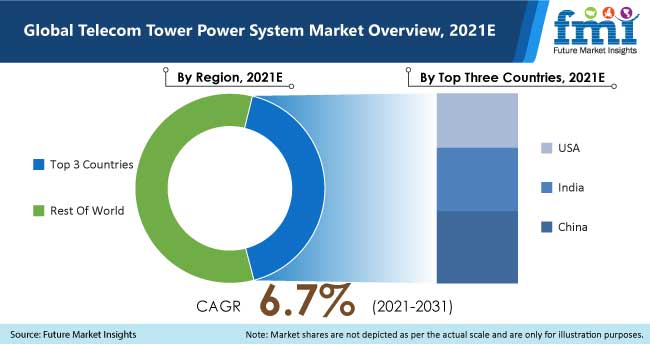
The telecom tower power system market is expected to register year-on-year growth at 5.8% in 2021, with the overall valuation forecast to reach US$ 3.5 Bn. As per a Future Market Insights (FMI) analysis, sales of telecom tower power systems is expected to increase at 6.7% CAGR between 2021 and 2031.

According to the study, the overall telecom tower power system market worth is expected to reach US$ 6.7 Bn by 2031. While outdoor telecom tower power systems are expected to remain dominant, indoor telecom tower power system will witness a surge in demand, exhibiting growth at 7.1% CAGR in 2021.

Request a Complete TOC of this Report with figures: https://www.futuremarketinsights.com/toc/rep-gb-444

Key Takeaways from Telecom Tower Power System Market Study

  • Outdoor telecom tower power systems are projected to hold over 54% of the global market share in 2021, supported by the availability of superior configurations.
  • The diesel generator + battery segment is set to hold over 41% of the market share as a power source by 2031-end, supported by investments into renewable energy systems.
  • The U.S. will remain a primary market, backed by rising demand from the energy sector. It is expected to account for over 86% of the demand registered in North America in 2021.
  • The markets in India and China are set to surge at CAGR of approximately 8% and 7% over the coming decade.
  • Russia is emerging as a key market in Europe, with a valuation of over US$ 154.5 Mn in 2021, driven by presence of massive telecom infrastructure network.

“The telecom tower power system market is growing at a strong pace driven largely by increasing demand for energy efficient power systems. Increasing investments in the telecommunication industry for the expansion of telecom infrastructure projects will create extensive opportunities for telecom tower power system manufacturers. Industry participants are investing in expansions, strategic alliances, and energy efficient solutions to gain a competitive advantage,” says a Future Market Insights analyst.

Who is Winning?

The telecom tower power system market is moderately consolidated, with key players accounting for more than 55% of the market share. These players are likely to invest in new technology developments and expansion of their distribution networks in order to maintain their market presence.

Some of the key players in this industry include but are not limited to 

  • Delta Electronics Inc.,
  • Cummins Inc.,
  • Huawei Technologies Co., Ltd,
  • Eaton Corporation PLC,
  • Vertiv Group Corporation,
  • STMicroelectronics NV,
  • ZTE Corporation, and
  • ABB Ltd.

Find More Valuable Insights

The research report analyzes demand for telecom tower power system. The global telecom tower power system market has been analyzed with the COVID-19 impact, various macroeconomic factors, market trends and market background. As per Future Market Insights, the market has been analyzed on the basis of product type, power source, and region. The report provides qualitative and quantitative information on various players in this market. This report also tracks the market by both, supply side and demand factors.

Ask us your Any Queries About this Report: https://www.futuremarketinsights.com/askus/rep-gb-444

About Industrial Automation Division at Future Market Insights

The Industrial Automation & Equipment division at FMI adopts a novel approach and innovative perspective in analyzing the global machinery and industrial automation market. A range of FMI’s market research reports offer comprehensive coverage of capital, portable, process, construction, industrial, and special purpose machinery used across manufacturing sector. The team also conducts distinctive analysis about installed base, consumables, replacement, and USP-feature application matrix, making us a prominent voice of authority in the industry. We are associates of choice for established as well as budding industry

Flooded Battery to Remain Top Choice across Industries, Accounting for 49.0% of Lead Acid Battery Sales in 2021: Future Market Insights

The global sales of lead acid battery are set to be valued at over US$ 54.3 Bn in 2021, with a stable long-term projection, according to latest insights by Future Market Insights (FMI). The report has forecast the market to expand at over 5.2% CAGR between 2021 and 2031.

According to the market analysis by Future Market Insights, expansion of automotive production facilities to cover rural and other remote areas has led to the increasing demand for lead acid battery. Rapid technological advancements in production technologies are also projected to complement market growth over the coming years.

Demand for lead acid battery is increasing with the rise in the volume of vehicle fleet in recent years. This can be attributed to an increase in aftermarket sales in regular interims for battery replacement.

Request a Complete TOC of this Report with figures:
https://www.futuremarketinsights.com/toc/rep-gb-54

The growing requirement has led to mass production and has increased importance of process automation in the lead acid battery market. The market is shifting towards industry 4.0 s, leading to the universal adoption of new production technologies.

There also is an increasing demand from other industries for deployment of lead acid battery. Increasing number of players focusing on research and development related to lead acid battery is anticipated to have a significant contribution towards market growth in the years to come.

Key Takeaways from Lead Acid Battery Market Study

  • Flooded battery is projected to hold over 49% of the global market share in 2021 in terms of product type, supported by superior configurations.
  • Transportation is projected to hold over 56% of the overall market share as leading segment in terms of application by 2031-end, supported by increasing investments in electric vehicles production.
  • China will remain a chief market, backed by rising demand from the automotive industry. It is expected to account for over 57.3% of demand registered in East Asia in 2021.
  • The markets India is set to surge at around 6% CAGR over the next ten years.
  • Germany is emerging as a key market in Europe, accounting for over US$ 2,509.4 Mn in 2021, driven by expansion of the automotive industry.

“The lead acid battery market is growing at a strong pace, driven largely by increasing demand for energy efficient solutions across automotive sector. The increasing demand for electric vehicles will create extensive opportunities for manufacturers. Key industry participants have been focusing product diversification to offer energy efficient solutions and gain a competitive advantage,” says a Future Market Insights analyst

To remain ‘ahead’ of your competitors, request for a sample @ https://www.futuremarketinsights.com/reports/sample/rep-gb-54

Lead Acid Battery Market by Category

By Product Type:

  • Flooded Battery
  • AGM Battery
  • Gel Battery

By Application:

  • Transportation
    • Passenger Cars
    • LCV
    • HCV
    • Two wheelers
    • Others
  • Motive Industrial
  • Stationary Industrial
  • Commercial
  • Residential
  • Grid Storage
  • Others

By Sales Channel:

  • OEM
  • Aftermarket

By Region:

  • North America
  • Latin America
  • Europe
  • South Asia & Pacific
  • East Asia
  • Middle East and Africa (MEA)

Competitive Landscape

The lead acid battery market is highly competitive at regional as well as global levels, and highly consolidated in nature. These players are likely to invest in new technology developments and expansion of their networks in order to maintain their market shares.

Some of the key players in this industry include but are not limited to Furukawa Electric Co., Ltd., Narada Power Source Co. Ltd., Clarios, Leoch International Technology Ltd., Enersys, Exide Industries Ltd., GS Yuasa Corporation, East Penn Manufacturing Co., Chaowei Power Holdings Limited., and others.

For More Information or Query or Customization Before Buying, Visit: https://www.futuremarketinsights.com/customization-available/rep-gb-54

Find More Valuable Insights

The research report analyzes demand for Lead Acid Battery. The global Lead Acid Battery market has been analyzed with the COVID-19 impact, various macroeconomic factors, market trends and market background. As per Future Market Insights, the market has been analyzed on the basis of product type, power source, and region. The report provides qualitative and quantitative information on various players in this market. This report also tracks the market by both, supply side and demand factors.

Pressure Reducing Valve Market is predicted to expand at a steady CAGR of 4.5% and reach a net worth of US$ 2,588 Mn by the end of 2028.

[275 Page Report] FMI reveals that the global pressure reducing valve market enjoys a valuation of US$ 1,998.1 Mn in 2022, and is predicted to expand at a steady CAGR of 4.5% and reach a net worth of US$ 2,588 Mn by the end of 2028.

According to the analysis, the demand for pressure reducing valves is expected to keep increasing over the years. Growing investments in the oil & gas and chemical industries are expected to be the key factors assisting the growth of the global pressure reducing valve market.

To remain ‘ahead’ of your competitors, request for a sample @
https://www.futuremarketinsights.com/reports/sample/rep-gb-3784 

The global market for pressure reducing valves is estimated to be valued at US$ 1,701.6 Mn by the end of 2022 and is expected to witness a Y-o-Y growth rate of 4.3% over the forecast period. China is estimated to account for a significant value share in the global pressure reducing valve market by 2022 end and is expected to remain dominant throughout the forecast period in the pressure reducing valve market.

The pressure reducing valve market has been experiencing significant growth for years now, particularly in Middle East & Africa, India and China. The growing demand for oil & gas, chemicals and power across GCC Countries and India is contributing to the substantial demand for pressure reducing valves in these regions.

However, the global pressure reducing valve market is expected to face certain challenges. Manufacturers have to follow certain regulations pertaining to pressure reducing valves, which include ASME and JIS.

Prominent manufacturers are involved in introducing pressure reducing valves while adhering to the international regulations and certification in order to enhance their presence in the market. This is expected to be one of the key trends identified in the global pressure reducing valve market.

Segmentation Analysis
  • Based on product type, the direct acting segment is expected to dominate the pressure reducing valve market over the forecast period
  • Based on material, the ductile iron segment is expected to register the highest growth, in terms of volume as well as value, in the global pressure reducing valve market over the forecast period
  • Based on operating pressure, the 50-200 Psig segment is expected to account for more than 2/5th of the overall incremental opportunity created in the global pressure reducing valve market during the forecast period
  • Based on application, gas and liquid segments, together, are expected to create an incremental opportunity1.7X that of the steam segment’s in the global pressure reducing valve market
  • Based on end-use industry, the chemical segment is pegged to remain dominant in the global pressure reducing valve market throughout the forecast years

For critical insights on this market, request to ask an expert here @
https://www.futuremarketinsights.com/ask-question/rep-gb-3784 

Regional Analysis

Western Europe and China together are estimated to have collectively accounted for more than 2/5th of the overall share in the global pressure reducing valve market by the end of 2017. The Middle East & Africa region is a key production base for the oil & gas industry and thus the region is expected to create significant growth opportunities in the global pressure reducing valve market.

Vendor Insights

The report highlights some of the top companies operating in the global pressure reducing valve market such as Watts Water Technologies, Inc., Spirax Sarco Engineering plc, TLV, Itap Spa, Caleffi S.p.a., HAWE Hydraulik SE, Yoshitake Inc., Genebre, HYDAC, Forbes Marshall, CIRCOR International, Inc., Armstrong International Inc. and Fushiman Co., Ltd.

For More Information or Query or Customization Before Buying, Visit:
https://www.futuremarketinsights.com/customization-available/rep-gb-3784 

About Industrial Automation Division at Future Market Insights

The Industrial Automation & Equipment division at FMI adopts a novel approach and innovative perspective in analyzing the global machinery and industrial automation market. A range of FMI’s market research reports offer comprehensive coverage of capital, portable, process, construction, industrial, and special purpose machinery used across manufacturing sector. The team also conducts distinctive analysis about installed base, consumables, replacement, and USP-feature application matrix, making us a prominent voice of authority in the industry. We are associates of choice for established as well as budding industry

For more insights, write in to press@futuremarketinsights.com